Thursday, October 11, 2018

how to conquer your math phobia!


We're going to conquer MATH ^PHOBIA^. 

Remember matphobia is a behavior. You do it, it's in your mind.  Why? You're afraid. 

What to do? You have to develop a counter disposition that ends up winning. A new math disposition. And it requires that you re-wire your math-rejecting brain into a math-proficient brain.

First: Get yourself a decent tutor. Do you have to pay? It's worth it
 
HOW TO DEVELOP A MATH-PROFICIENT BRAIN

1. Work always from the easy to the difficult. Never jump to a new topic without understanding the previous one.  Math understanding is cumulative
2. If you don't get it, take a break. Start all over. Don't ever throw the towel.
3. Do math little by little. DON'T RUSH. 
4. Practice makes perfect. Move from easy to medium to difficult. Work, work, work. 
5. Develop a relationship with your math teacher. Go to her office. Show her that you want to grow your skills. Ask her questions (teachers love a committed student). 

Identify your math weaknesses: Fractions? algebra? analytic geometry? trigonometry? Revise your knowledge. Take it from the beginning. Word problems? Take it from the easy to the difficult. Don't quit.


Wednesday, October 10, 2018

college achievement in math and science for latinos & blacks


Dear class, thanks for an interesting class discussion. Remember, the points we discussed pertain a specific position known as Hard Determinism. What's at stake here is free will. Hard Determinism declares that what people do is caused by previous entrenched dispositions (i.e., cultural, social, psychological, etc).

click here for the study of the graph (above),
Academic preparation and racial disparities in K-12 education clearly play a role in who graduates from college. Also the report argues "lack of resources at open-access colleges is one of the main causes of high dropout rates…among less advantaged students, including less advantaged Latino students" (according to the link above).
click here for more information,
Of the total population of students who passed Algebra I in Grade 8 (2015-1016), 64% were white, 17% were Latino, 9% were black (according to the link above).
declining numbers of blacks in math and science,
Black people are 12% US population and 11% of all students beyond high school. In 2009, they received just 7% percent of all STEM bachelor's degrees, 4% percent of master's degrees, and 2% percent of PhDs, according to the National Center for Education Statistics. From community college through PhD level, the percentage of STEM degrees received by blacks in 2009 was 7.5 percent, down from 8.1 percent in 200 (according to the link above).

what is a synapse? (the most basic brain state)

click here for more information.

homework, chapter 5

1. what is the problem of free will,
2. define hard determinism.
3. what is compatibilism? explain traditional compatibilism.
4. what is libertarianism?
5. what is sartre's "profound freedom"?

Sunday, October 7, 2018

chapter 6 summary (monday 5:40pm class)

a brief history of epistemology, 
epistemology's main characters, 
homework for chapter 6,  (based on my notes)

what is the mind? finally!

Functionalism: MS ↔ FS When two things perform the same function, they are said to have the same “causal role.” Functionalism claims that THE MIND IS WHAT THE BRAIN DOES.

If a robot and a human can perform the same task (same causal role), they are said to be in the same state of mind. Something else about functionalism is that mental states can cause other mental states, i.e., if you see your boyfriend cheating (input), the following mental states may occur (outputs): 1- shock, 2- jealousy, 3- bitterness, (even vengeance).

Counterexamples to Functionalism 

Putnam's inverted spectrum case:  Imagine an individual is born with an inverted color spectrum. What is red she sees green and vice-versa. Then she learns how to tell the difference. She grows up and gets her driver's license. If you asked her: “What color is the top light of the traffic light? She would say RED (she sees it GREEN). Her visual experience (the qualitative content - the feel IS VERY DIFFERENT FROM THE REST OF US). This proves that not every time we are in a functional state (STOPPING AT A RED LIGHT) we are in the same MENTAL STATE. 

Lewis' mad man experiment: A person feels a headache but instead of going "ouch" (the function of pain) he studies calculus. Here he's in the same mental state normal people are, but in a different functional state. This proves one can be in a mental state and not in the same functional state.


TURING TEST FOR INTELLIGENCE: Imitation game. There is a man (A) and a woman (B) and an interrogator (C) who may be of either sex. → The object of the game is for the interrogator to determine which of the two is the man and which is the woman. → It is A’s object in the game to try to cause C to make the wrong identification. The object for the game of B is to help the interrogator.
For Turing there’s nothing more to being intelligent than being able to use language as we do. WHICH MEANS… If a computer is able to do this, then it is smart.


WHAT DO WE LEARN? MENTAL STATES ARE NOT REDUCIBLE TO BEHAVIORAL STATES, TO BRAIN STATES, TO FUNCTIONAL STATES. MENTAL STATES ARE IRREDUCIBLE. WE CALL PROPERTY OF MENTAL STATES A PRIMITIVE PROPERTY.
 

INTENTIONALITY IS A PRIMITIVE PROPERTY, it's the “ABOUTNESS” of a thought. Without intentionality our life would be completely mechanical. 

A SYNONYM FOR INTENTIONALITY IS QUALIA, i.e., the unique private subjectifve "feel" of our mental states. 

here's my analysis of the mind as SYSTEMIC PROPERTY OF THE BRAIN. 

this is a sketch of a systemic model for the mind (going up emergence, going down supervinience)

emergent property → is a property which is caused by things that lack that property & interact in certain ways. IN SISTEMS THE WHOLE IS BIGGER THAN THE PARTS. The emergent property arises when all parts are put together. ● The mind is emergent upon and caused by brain activity. EX: Love at first sight. ● Life is an emergent property. ● HURRICANES (wind-rain-destruction) ← ALL of these variables MUST happen in order for the emergent property to arise.

click here for examples of emergent properties,

Downward causation → Downward causation is used to explain the effect of the environment on biological evolution. It suggests the causal relationship between the HIGHER levels of a system to LOWER levels of that system. For example: mental events causes physical events. There is a two-way interaction between consciousness and the brain: Consciousness determines the succession of nerve impulses, and nerve impulses determine the content of consciousness.

click here for a better understanding of the brain-systemic-model for the mind,

Tuesday, October 2, 2018

chapter 1 summary (monday 5:40pm class)

click here, homework chapter 1 
click here, fallacies,
click here, deductive and inductive arguments
click here, necessary and sufficient conditions,
click here, the presocratics,
click here, branches of philosophy,
click here, (office hours)

homework, chapter 1 (monday 5:40pm class)

click here for more information,

homework, chapter 1 (monday 5:40pm class)

1. what is the philosophical method?
2. what does Socrates mean by "examined" life?
3. a) what's a premise? b) what's a conclusion? c) what's an argument?
4. when is an argument deductive?
5. what's an inductive argument?
6. when is a deductive argument valid?
7. when is an inductive argument strong?
8. revise the points on pages 30-32
9. what's a fallacy? 

Here is the latest as per our Philosophy Club

Malena Arriola, president,
Rachel Apply, vice president, 
Ariel Trawick, treasurer, 
Anna Righini, secretary,  
Sophie Leutenegger, event planner,

Thursday, September 20, 2018

Wednesday, September 19, 2018

our ideas about the world need to be informed by FACTS about the world (10 much discussed points)

our views of the world need to be informed. to be informed one has to inform one's views from all angles. statistics help. there are armies of experts tabulating information. now, reliability in statistics, like in any other factual endeavor is a matter of sedimentation (i.e., obtaining information that validates the result over time). so, here are 10 random samples:

1. in the discussion of marijuana, my students are generally pro legalization. are they aware that the marijuana today is quite different from the "pot" of the flower generation? here is the study. 

2. in the discussion about family roles of men & women, one needs to know how society presents itself. this study will surprise you. 

3. 43% of women leave the workforce after having children. that's the number, now, let's not jump into conclusions.

4. take the pareto distribution rule to explain why 20% of the population basically is basically richer than the remaining 80% (no matter what you try to do to change it).

5. latino college students are falling behind whites and blacks,

6. i'm not kidding when i say absenteeism and academic productivity are directly proportional?

7. millennials are reading more than the previous generation: GOOD,

8. as per our political inclinations... (read carefully),

9.  minorities resent one another as much as they do whites (1996 poll), 

10. as per immigration (80% close the border, 70% end chain migration),

Monday, September 17, 2018

a brief history of epistemology

click here for more information.

Whatever happens is perfect

dead British soldiers at the battle of Fromelles, 1916


you've heard me saying "whatever happens is perfect". here's why:

* in actuality (as something happens) global cause and effect cannot be undone.
* in actuality (as something occurs) global agent decisions cannot be undone.
* once something happens there are sufficient reasons for it to happen. 

a) as per history:

* history is one big glunk (the whole history is one big history of little histories), 
yet,
* history is not the summation of all events (since not all events are, or will be recorded in history), 
* history is not in time, since time is not a bucket/container of anything, 
rather,
* time is a mode of being of reality: time is the becoming of reality. 
as a result,
* from the future we cannot cherry-pick globally (while ignoring local regions),

b) as per necessity:

* whatever happens necessarily happens (otherwise SOMETHING ELSE would happen),
* what happens supervenes on the agents contributing the diverse processes including the agents themselves,

c) we get a distorted view of the past through PRESENTISM:

* presentism is the distortion that the present is normatively better than the past,
* the past cannot be retrofitted into a principle of satisfaction: it is what it is,
* the past can only be understood as IT WAS, not as a subjunctive modality ("it should've been" this or that). 
* to understand the past ONE HAS TO GO TO THE PAST, rather than bring the past to the present.

thanks,

Wednesday, September 5, 2018

Scientific Theories, Laws and Criteria of Adequacy

A scientific theory is a system of explanations of aspects of the natural world whose parts should have been tested and verified in accordance with the scientific method, using accepted protocols of observation, measurement, and evaluation results. Where possible, theories are tested under controlled conditions in an experiment. Here are some examples:

* cell theory, (Biology)
* atomic theory, (Physics)
* Big Bang theory, (Physics)
* Plate tectonics, (Geology)

Are theories revised? YES. All the time. As new discoveries are made, the theory needs to be tweaked and revised. The reason is that theories have many different parts and the parts are put together by inferential conclusions.

The distinction between scientific theory & scientific law 

Scientific laws and scientific theories are produced from the scientific method through the formation and testing of hypotheses, in order to predict the natural world. Both are typically well-supported by observations and/or experimental evidence. Scientific laws are descriptive accounts of how nature will behave under certain conditions. Scientific theories are broader in scope, and give overarching explanations of how nature works and why it exhibits certain characteristics.

So, for example, Newton's Second Law, F = ma is a formula.

(It states that the acceleration of an object as produced by a force is directly proportional to the magnitude of the force, in the same direction as the force, and inversely proportional to the mass of the object).

This formula belongs in a body of theories known as Classical Mechanics. Classical mechanics, is a branch of Physics that describes the motion of macroscopic objects, from projectiles to parts of machinery, and astronomical objects, such as spacecraft, planets, stars and galaxies.

Whereas laws should obtain all the time, theories incorporate laws with the purpose of explaining more general phenomena. They both explain, but laws are simpler.

____________

We need good explanations. In order to achieve this, we need to create a criteria of adequacy. Here are five points:

● Simplicity → Quality of relying on only a small number of assumptions (less is more).
● Scope → The amount of diverse phenomena (more is more).
● Consistency/Coherence → Lack of contradictions. (especially internal contradictions)
● Fruitfulness → The number of new facts predicted or problems solved (ability to make predictions).
● Conservatism → Quality of fitting well with existing theories (previous conclusions).

Thursday, August 30, 2018

Wednesday, August 29, 2018

branches of philosophy


Philosophy: according to Socrates it is the pursuit of truth. There is only ONE truth. 

Metaphysics: which deals with the fundamental questions of reality.
Epistemology: which deals with our concept of knowledge, how we learn and what we can know. Logic: which studies correct reasoning, the rules of valid reasoning and argumentation.
Axiology: study of value, with two sub-branches:
Ethics: or moral philosophy, which is concerned with human values and how individuals should act. Aesthetics: deals with notions of "taste," beauty/ugly, good/bad, and the philosophy of art.

______

The Socratic Method: 

Philosophy is founded in the Socratic Method. The method consists in the pursuit of truth through a question-answer dialogue where propositions are methodically scrutinized in order to uncover the truth.

Tuesday, August 28, 2018

"i'm bored"... remember curiosity and perseverance?

check this article, now you go into the world and give advice to people,

the point I want to make to you is that variables are constantly exchanged all across our psycho-social axes. curiosity and perseverance are essential for self-control, which is essential for anger and weight control! 

blacks and latinos underrepresented in STEM careers


click here for more information,

Wednesday, July 18, 2018

Monday, July 16, 2018

Topics for Exam #3, SUMMER A (revised after our class)

Topics for review for Exam #3 on Chapter 4 are here.

Here is the link to your textbook. Do the tests for chapter 4.

If you have any questions, post them in this post. I'll try to get to them ASAP.

Why being a woman is more than being a woman (Summer A)

I wrote this post in my personal blog m.bourbaki thinking of you guys. You're more than welcome to leave a comment, in agreement or disagreement (leave your comment at the  m.bourbaki site).

Monday, July 2, 2018

Plagiarism & how to fight it (read carefully)


In order to finish your assignment quickly, you may feel tempted to just copy and paste info. It's so obvious; just underline the paragraph, copy and paste it. DON'T!

I will detect the copy and edited text and send it back immediately along with a warning. Save yourself the embarrassment.

How do I know it's not yours? It's a matter of style. Your writing (as good or bad as it may be) has a specific flavor. Writing reflects the way you think and talk, which is a well-known aspect of how syntax relates to semantics.  When one inserts notes and paragraphs here and there, even a not-so-clever writer is able to detect the disparateness within the whole thing. There is a new field of semiotics in plagiarism. 😂 

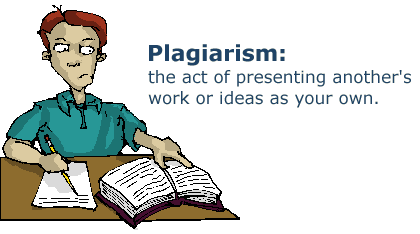
What is plagiarism? Using ideas, words, or a product without crediting the original source.
Passing off someone else's ideas, words, or product as your own.
Presenting as a new idea or product created by someone else.

More bluntly? Plagiarism is conceptual theft and goes against the US Copyright law and the USFSP Code of Conduct.

How can you avoid plagiarism? Just cite where you got your information.

As you research, keep track of the books, articles, and other resources you consult WHILE you do your research. This will save you time from having to track down where you originally found your information for your Reference List. For each source, keep a list of the following information:

For a Book
Author, Book Title, Place of Publication, Publisher, and Date of Publication 

For an Article

Author, Article Title, Journal Title, Volume Number, Issue Number, Page Numbers, Year of Publication, and the date of when you viewed the article

For a Webpage

Author, Web Page Title, the URL (website address), and the Date (when you viewed the webpage).