Monday, July 2, 2018

Plagiarism & how to fight it (read carefully)


In order to finish your assignment quickly, you may feel tempted to just copy and paste info. It's so obvious; just underline the paragraph, copy and paste it. DON'T!

I will detect the copy and edited text and send it back immediately along with a warning. Save yourself the embarrassment.

How do I know it's not yours? It's a matter of style. Your writing (as good or bad as it may be) has a specific flavor. Writing reflects the way you think and talk, which is a well-known aspect of how syntax relates to semantics.  When one inserts notes and paragraphs here and there, even a not-so-clever writer is able to detect the disparateness within the whole thing. There is a new field of semiotics in plagiarism. 😂 

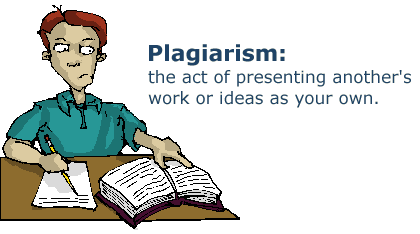
What is plagiarism? Using ideas, words, or a product without crediting the original source.
Passing off someone else's ideas, words, or product as your own.
Presenting as a new idea or product created by someone else.

More bluntly? Plagiarism is conceptual theft and goes against the US Copyright law and the USFSP Code of Conduct.

How can you avoid plagiarism? Just cite where you got your information.

As you research, keep track of the books, articles, and other resources you consult WHILE you do your research. This will save you time from having to track down where you originally found your information for your Reference List. For each source, keep a list of the following information:

For a Book
Author, Book Title, Place of Publication, Publisher, and Date of Publication 

For an Article

Author, Article Title, Journal Title, Volume Number, Issue Number, Page Numbers, Year of Publication, and the date of when you viewed the article

For a Webpage

Author, Web Page Title, the URL (website address), and the Date (when you viewed the webpage).

Wednesday, June 27, 2018

topics for midterm exam (Summer A)

Click here for the topics to the midterm exam.

Click here for a link to your textbook's tests and notes. 

Remember to bring your own scantrons (and a pencil) to our test.  

To all my Student Assistants for Tuesday and Thursday classes: Is there a possibility to coordinate a review for our Midterm coming up next Tuesday?

Tuesday, June 26, 2018

Triff Office Hours (room 3604-28)

M,W,F, 7:50am-10:20am
T,R, 7:50-9:40am


Saturday, June 9, 2018

homework, chapter 3 (summer A)

Homework 1

1. what is ethics?
2. are there moral values? where do moral values come from? click here for triff's lecture on moral judgments, 
3. what's overridingness?
4. what do moral theories explain?

5. what is the difference between moral absolutism and moral objectivism?
6. what is moral relativism?
7. explain the difference between subjective relativism and cultural relativism.

Homework 2

1. explain the difference between act and rule utilitarianism (target your answer in following the example of the terminally ill woman on p. 156).
2. jeremy bentham and john stuart mill have different views on the nature of happiness. explain.
3. read the death penalty example on page 160 (between retentionists and abolitionists). the discussion pivots on utilitarianism.
4. answer questions 1-5 from section 3.3 p. 169

Homework 3

1. Define pertect and imperfect duties.
2. What is Kant's Categorical Imperative?
3. Explain Kant's Second Formulation

Homework 4,
1. What is virtue according to Aristotle?

Thursday, June 7, 2018

Topics for Exam #1 (SUMMER A)

Find the topics here.

Also here's a link to your Doing Philosophy textbook.  
Click the different chapters, then on the left hand side click the corresponding sections. There are True/False and Multiple Choice Questions. Test yourself.

You should bring your own scantrons: #888-P or #882-E

Friday, April 27, 2018

what to do with EROS?

click here for a triffean perspective,

Review for Final Exam (open to all classes)

You already know hoe important it is to get a help from a SA. Well, Rohama Bruk (T,R 11:15am class) will be at the Learning Spot, next Tuesday May 1st, from 2-5pm reviewing paper assignments. 

In addition she is conducting a final review on Wednesday, May 2nd, from 11-12:30pm, at the same place. Don't miss it. 

Thank you Rohanna!

Wednesday, April 18, 2018

final exam schedule (all classes)

honors 10am, may 2
honors 11am, may 4
honors, interamerican, may 2
t,r 8:25am, may 3
t,r 11:15am, may 3
t 5:40pm, may 1

Friday, April 13, 2018

Wednesday, March 28, 2018

I'm the best! (and you too)


I'm a self-centered pluralist. It means I'm the best.

I'm also an ethnocentric pluralist. It means my people (Lebanese, and more particularly Maronite Lebanese) are the best.  

Now, very important: My being the best does not exclude many other bests.

Here's the definition for "best" from the dictionary: One that surpasses all others.

Ok, now "surpasses all others" needs to be qualified. 

In what respect I surpass all others? 

I surpass all others precisely in my being this particular individual that I am. All the notes that make me myself.

Say, temporal notes (about the time I've lived so far), character notes (character is the set of all consensual behaviors of witnesses about me), psychological notes (memories, desires, hopes, etc),
physical notes (gender, sex, race, endurance, etc), behavioral notes (what I do in the world), skill notes (what I'm good at), etc. You get the idea. 

The same with you, with similar results.

Suppose you retort: well, you're not a better cook than Daniel Boulud, are you? So how could you be best? I'm not saying being best chef, nor the best French chef, which means being best in all possible French-chef notes. Boulud (whom I admire) is the best French chef I know, but not the best Chinese chef, nor the best Mexican Chef, and so on.

Best is not an unqualified universal category. 

"Best" is more a regional category, otherwise there's no way to even know what's best. As when I say: 

"John (my mechanic) this is the best SAAB mechanic in Coral Gables." I don't doubt there are better mechanics than John in Miami.   

"Best" is function of all the notes that make a respective particular.

f(ni) = p

Why is this good? Because without a balanced sense of SELF & community one is more prone to be dispossessed.

Saturday, March 24, 2018

Wednesday, March 21, 2018

professor ed frenkel discusses professor langland's contributions to mathematics

i know that some of the stuff we do in class is "out-there" and sometimes you resist it. well, here is a great russian mathematician, ed frenkel, from UC Berkley talking about professor langland's contributions to mathematics. check 7:30, when frenken presents the question: if there are aliens, would they use the same mathematics we use? or 10:48, where he hypothesizes how numbers are tied to our practical human tasks (supposing aliens had tasks). this is a great lecture for all of you, not only math enthusiasts! here is professor frenkel's personal website.